What is it?
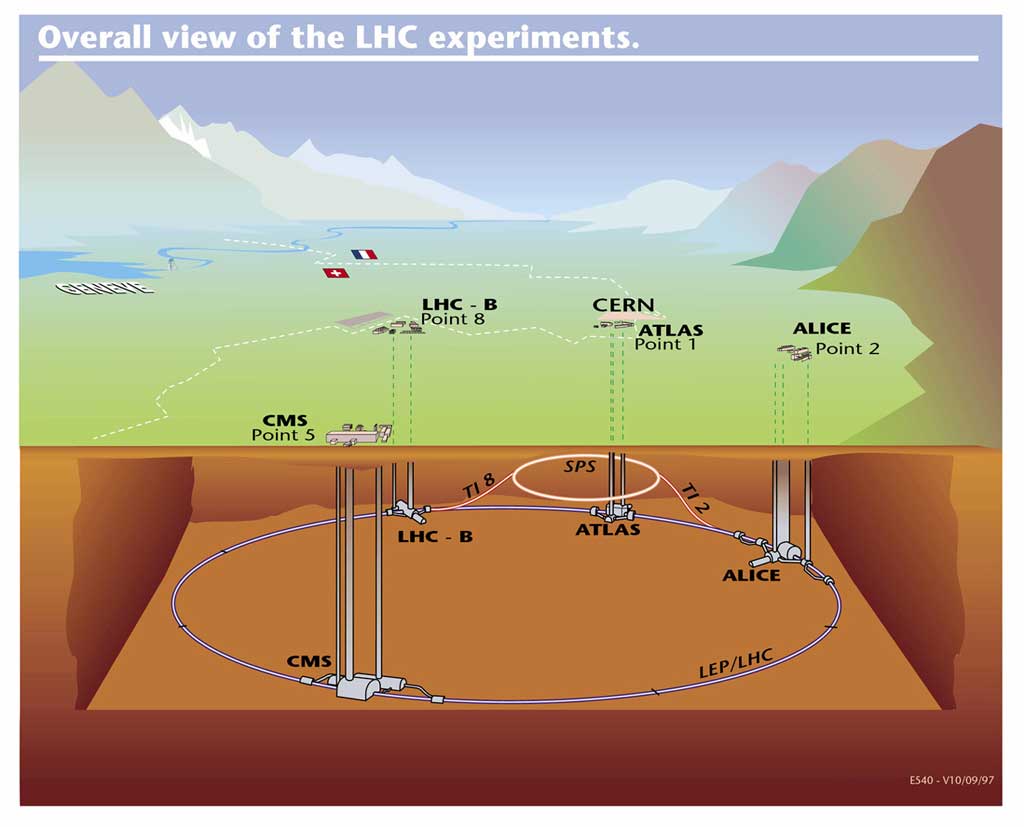
The LHC, also known as the Large Hadron Collider, is the world's largest and most powerful particle collider ever built. It is built in a circular tunnel of a 27km circumference. The tunnel is buried underground around 50 to 150 metres.
Who operates it?
The LHC is operated by CERN, which is the European Laboratory of Particle Physics.
Where is it?
The LHC is located near Geneva, with the previous accelerator of CERN. The ring sits underground, astride the border of Switzerland and France.
Why build it?
The purpose of building a particle collider, is to perform high energy physics experiments in order to research on the fundamental stucture of the universe. Inside the accelerator, hadrons, which are protons or lead ions in this case, will be accelerated to collide in the centre of the detecters, in order for scientists to study the phenomena occur in the collision. Some of the experiments which were being assigned to the LHC include:
- searching for Higgs boson*1
- searching for dark energy and dark matter*2
-
detecting antimatter*3
- *1: Higgs boson: a hypothetic particle predicted by theoretical physicists, also given a nickname of "the God particle"; it is the particle that gives all matter mass.
- *2: Dark energy and Dark matter: a hypothetical type of energy/matter that cannot be detected directly because it does not interact with light, but can only be inferred from gravitational effects on visible matter; according to cosmologies and physicists, 70% of the existing universe is dark energy, and 25% of it is dark matter.
- *3: Antimatter: the extension of the concept of antiparticle in particle physics; antimatter is composed of antiparticles, where as matter is composed by regular particles. For example, the antiparticle of an electron is a positron. Mixing matter and antimatter together will cause them to annihilate each other and transform to energy.
How does it work?
As beams of particles are being released to the vaccum of the accelerator tunnel, superconducting magnets will produce powerful magnetic field to bend and accelerate them. These electromagnets are kept at a temperature about 1.9K, which is ‑271°C (even colder than the outer space!) in order to produce such a strong magnetic field as needed by performing the experiments.
Firstly, particle beam are accelerated to 99.999999% of the speed of the light; then, 1232 dipole magnets of 15m length are used to bend the particle beams into a circular path. Afterwards, 392 quadrupole magnets with the length of 5-7 metres for each are used to focus the beams and squeeze the particles closer together to increase the chances of collisions.
Generally, around 3000 superconducting electromagnets are used in the LHC. The highest energy level of this collider is as high as 7 Tev per beam, which is 1x10¹⁰ tonnes of TNT equivalent per kilogram.