
Picture above: layout of the LHC
There are 4 large detecters: ALICE, ATLAS, CMS, LHCb and 2 smaller detecters: TOTEM and LHCf.
ALICE

Detecter ALICE: A Large Ion Collider Experiment
- size: 26 m long, 16 m high, 16 m wide
- weight: 10 000 tonnes
- design: central barrel plus single arm forward muon spectrometer
- location: St Genis-Pouilly, France
ALICE is an experiment of the LHC at CERN. The ALICE collaboration is building a heavy-ion* detecter to exploit the unique physics potential of nucleus-nucleus interactions at LHC energies. ALICE studies the physics of strongly interacting matter at extreme energy densities, where the formation of a new phase of matter, the quak-gluon plasma*, is expected. The existence of such a phase and its properties are key issues in QCD* for the understanding of confinement and of chiral-symmetry* restoration. For the purpose, the ALICE intends to carry out a comprehensice study of the hadrons*, electrons, muons*, and photons produced in the collision of heavy nuclei. ALICE will also study proton-proton collisions both as a comparison with lead-lead collisions and in physics areas where ALICE is competitive with other LHC experiments.
*ion: an atom or molecule where the total number of electrons is not equal to the total number of protons, giving it a net positive or negative electrical charge. An "anion" is an ion with a negative charge, and a "cation" is an ion with a positive charge.
*plasma: a partially ionized gas, in which a certain proportion of electrons are free rather than bound with an atom or molecule. A plasma is considered distinct from gases, solids and liquids which it becomes the fourth state of matter.
*QCD: Quantum Chromaticdynamics. The theory of strong interaction, a foundamental force describing the interactions of quarks and gluons making up hadrons.
*chiral-symmetry: a possible symmetry of the Lagragian under which left-handed and right-handed parts of Dirac fields transform independently.
*hadron: a particle made of quarks held together by the strong force. Hadrons are either mesons (made of one quark and one antiquark) or baryons (made of three quarks).
*muon: an elementary particle similar to electron, with negative electric charge and spin of 1/2. Together with electron, tauon, and the three neutrinos, they are classified as a lepton.
Read more about ALICE on CERN website
ATLAS

Detecter ATLAS: A large Toroidal LHC Apparatus
- size: 46 m long, 25 m high, 25 m wide
- weight: 7000 tonnes
- design: barrel plus end caps
- location: Meyrin, Switzerland
ATLAS is an experiment of the LHC at CERN. The ATLAS detector researches for new discoveries in the head-on collisions of protons of extraordinary high energy. ATLAS will learn about the basic forces that have shaped out universe since the begining of time and that will determine its fate. Among the possible unknowns are the oringin of mass, extra dimensions of space, microscopic black holes, and evidence for dark matter candidates in the universe.
Read more about ATLAS on CERN website
Click to watch the constructing process of ATLAS on youtube
CMS
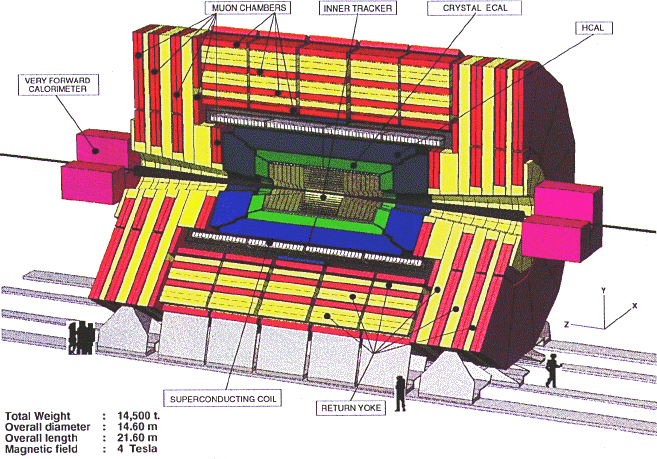
Detecter CMS: Compact Muon Solenoid
- size: 21 m long, 15 m high, 15 m wide
- weight: 12 500 tonnes
- design: barrel plus end caps
- location: Cessy, France
CMS is an experiment of LHC at CERN. The CMS detector is designed to see a wide range of particles and phenomena produced in high-energy collisions in the LHC. Like a cylindrical onion, different layers of detecter stop and measure different particles, and use the key data to build up a picture of events at the heart of the collision. Scientists then use this data to search for new phenomena that will help to answer questions such as: What is the universe really made of and what forces act within it? And what gives everything substance? CMS will also measure the properties of previously discovered particles with unprecendented precision, and be on the lookout formpletely new, unpredicted phenomena.
Read more about CMS on CERN website
LHCb

Detecter LHCb: Large Hadron Collider beauty
- size: 21 m long, 10 m high, 13 m wide
- weight: 5600 tonnes
- design: forward spectrometer with planar detecters
- location: Ferney-Voltaire, France
LHCb is an experiment of LHC at CERN. The LHCb detector aims for recording the decay of particles containing b and anti-b quarks, collectively known as "b mesons"*. The detector is specifically designed to filter out these particles and the products of their decay. Rather than flying out in all diections, B mesons formed by the colliding proton beams (and the particles they decay into) stay close to the line of the beam pipe, and this is reflected in the design of the detector. Other LHC experiments surround the entire collision point with layers of sub-detecters, like an onion, but the LHCb detecter streches for 20 meters along the beam pipe, with its sub-detecters behind each other like books on a shelf. Each of LHCb's sub-detecters speciallizes in measuring a different characteristics of the particles by colliding protons. Collectively, the detecer's components gather information about the identity, trajectory, momentem of each particle generated, and can single out individual particles from the billions that spray out from the collision point.
*meson: a type of subatomic particle composed of one quark and one antiquark. Mesons are part of the hadron family, along with baryon-particles made of quarks. The main difference between mesons and baryons is that mesons are bosons while baryons are fermions-mesons have integer spin while baryons have half-integer spin-meaning that Pauli's Exlusion Principle does not apply to mesons.
Read more about LHCb on CERN website
TOTEM
Detecter TOTEM: Total Cross Section, Elastic Scattering and Diffraction Dissociation
- size: 440 m long, 5 m high, 5 m wide
- weight: 20 tonnes
- design: Roman pot and GEM detecters and cathode strip chambers
- location: Cessy, France (near CMS)
The TOTEM experiment studies forward particles to focus on physics that is not accessible to the general purpose experiments. Among a range of studies, it will measure, in effect, the size of the proton and also monitor accurately the LHC's luminosity.
Read more about TOTEM on CERN webiste
LHCf
Detecter LHCf: Large Hadron Collider forward
- size: 2 detecters, each measures 30 cm long, 80 cm high, 10 cm wide
- weight: 40 kg each
- design: N/A
- location: Meyrin, Switzerland (near ATLAS)
The LHCf experiment use forward particles created inside the LHC as a source to simulate cosmic rays* in laboratory conditions.
*cosmic rays: naturally occuring charged particles from outer space that constantly bombard the Earth's atmosphere. They collide with nuclei in the upper atmosphere, leading to a cascade of particles that reaches ground level.
Read more about LHCf on CERN website
